Skip to content

01 / Why Datalobe

The hard parts of a migration, handled

Datalobe plans the whole move, converts the code your applications depend on and proves the result before you switch over.

  • 71of 100

    Tables in scope
    1,036
    Code objects
    540
    Findings
    214
    Estimate
    840 h

    See the whole job before it starts

    Readiness 71 of 100 for the sample ERP.

    Migration assessment
  • Oracle

    NVL(qty, 0)

    PostgreSQL

    COALESCE(qty, 0)

    Compiled on PostgreSQL 16.4

    Code that compiles before deploy

    540 of 540 objects compiled before deploy.

    • Every row counted
    • Values compared
    • Keys hold
    • 7 rounding warnings accepted
    • Functions give the same answers

    Switch over with evidence, not hope

    17,612 check runs, 0 failed, 18 min of downtime in the example run.

Explore the database migration platform

02 / Code conversion

Code objects are where migrations stall

AI converts the stored code, and every AI conversion is checked against the source, with a named person for anything that cannot be proven.

FIN.PKG_GL_POSTING (package, 14 procedures, package state)

Converted by AI · reviewed and edited by Marcus Reed

Oracle PL/SQL (source)
CREATE OR REPLACE PACKAGE BODY fin.pkg_gl_posting AS  g_batch_id NUMBER;   PROCEDURE post_journal(p_journal_id IN NUMBER) IS    v_total NUMBER;  BEGIN    SELECT NVL(SUM(amount), 0) INTO v_total      FROM fin.gl_journal_lines     WHERE journal_id = p_journal_id;    INSERT INTO fin.gl_postings (batch_id, journal_id, total)    VALUES (g_batch_id, p_journal_id, v_total);  END post_journal;END pkg_gl_posting;
PostgreSQL PL/pgSQL (target)
CREATE OR REPLACE FUNCTION fin_pkg_gl_posting.post_journal(  p_journal_id numeric(38,10))RETURNS void LANGUAGE plpgsql AS $$DECLARE  v_total numeric(38,10);  v_batch_id numeric(38,10);BEGIN  SELECT batch_id INTO v_batch_id    FROM fin_pkg_gl_posting.session_settings   WHERE session_id = pg_backend_pid();  SELECT COALESCE(SUM(amount), 0) INTO v_total    FROM fin.gl_journal_lines   WHERE journal_id = p_journal_id;  INSERT INTO fin.gl_postings (batch_id, journal_id, total)  VALUES (v_batch_id, p_journal_id, v_total);END;$$;

Becomes schema fin_pkg_gl_posting with functions and a session settings table.

INV.V_STOCK_POSITION (view, CONNECT BY)

CONNECT BY → WITH RECURSIVE

Oracle PL/SQL (source)
CREATE OR REPLACE VIEW inv.v_stock_position ASSELECT h.location_id, h.depth, s.item_id, s.qty_on_hand  FROM (SELECT location_id, LEVEL AS depth          FROM inv.locations         START WITH parent_id IS NULL       CONNECT BY PRIOR location_id = parent_id) h  JOIN inv.stock s ON s.location_id = h.location_id;
PostgreSQL PL/pgSQL (target)
CREATE OR REPLACE VIEW inv.v_stock_position ASWITH RECURSIVE h AS (  SELECT location_id, 1 AS depth    FROM inv.locations   WHERE parent_id IS NULL  UNION ALL  SELECT l.location_id, h.depth + 1    FROM inv.locations l    JOIN h ON l.parent_id = h.location_id)SELECT h.location_id, h.depth, s.item_id, s.qty_on_hand  FROM h  JOIN inv.stock s ON s.location_id = h.location_id;

HR.PRC_PAYROLL_CLOSE (procedure, DBMS_JOB)

Rewritten by hand by Daniel Ortiz · schedule moved to pg_cron

Oracle PL/SQL (source)
CREATE OR REPLACE PROCEDURE hr.prc_payroll_close ISBEGIN  UPDATE hr.payroll_periods     SET status = 'CLOSED'   WHERE end_date < TRUNC(SYSDATE)     AND status = 'OPEN';  COMMIT;END;/DECLARE  v_job BINARY_INTEGER;BEGIN  DBMS_JOB.SUBMIT(v_job, 'hr.prc_payroll_close;',                  TRUNC(SYSDATE) + 1, 'TRUNC(SYSDATE) + 1');  COMMIT;END;
PostgreSQL PL/pgSQL (target)
CREATE OR REPLACE PROCEDURE hr.prc_payroll_close()LANGUAGE plpgsql AS $$BEGIN  UPDATE hr.payroll_periods     SET status = 'CLOSED'   WHERE end_date < date_trunc('day', localtimestamp)     AND status = 'OPEN';  COMMIT;END;$$; SELECT cron.schedule('hr_payroll_close', '0 0 * * *',                     'CALL hr.prc_payroll_close()');

SALES.FN_ORDER_TOTAL (function)

NVL → COALESCE · DECODE → CASE

Oracle PL/SQL (source)
CREATE OR REPLACE FUNCTION SALES.FN_ORDER_TOTAL (  p_order_id IN NUMBER) RETURN NUMBER IS  v_total NUMBER(14,4);BEGIN  SELECT SUM(NVL(l.LINE_AMOUNT, 0)           * DECODE(l.IS_TAXABLE, 'Y', 1.2, 1))    INTO v_total    FROM SALES.ORDER_LINES l   WHERE l.ORDER_ID = p_order_id;  RETURN NVL(v_total, 0);END FN_ORDER_TOTAL;
PostgreSQL PL/pgSQL (target)
CREATE OR REPLACE FUNCTION sales.fn_order_total(  p_order_id numeric) RETURNS numericLANGUAGE plpgsql AS $$DECLARE  v_total numeric(14,4);BEGIN  SELECT SUM(COALESCE(l.line_amount, 0)           * CASE WHEN l.is_taxable THEN 1.2 ELSE 1 END)    INTO v_total    FROM sales.order_lines l   WHERE l.order_id = p_order_id;  RETURN COALESCE(v_total, 0);END;$$;

SALES.TRG_ORDER_AUDIT (trigger, autonomous transaction)

Rewritten by hand · caller change flagged

Oracle PL/SQL (source)
CREATE OR REPLACE TRIGGER sales.trg_order_auditAFTER INSERT OR UPDATE ON sales.ordersFOR EACH ROWDECLARE  PRAGMA AUTONOMOUS_TRANSACTION;  v_action CHAR(1) := CASE WHEN INSERTING THEN 'I' ELSE 'U' END;BEGIN  INSERT INTO sales.order_audit (order_id, action, changed_at)  VALUES (:NEW.order_id, v_action, SYSDATE);  COMMIT;END;
PostgreSQL PL/pgSQL (target)
CREATE OR REPLACE FUNCTION sales.trg_order_audit()RETURNS trigger LANGUAGE plpgsql AS $$BEGIN  INSERT INTO sales.order_audit (order_id, action, changed_at)  VALUES (NEW.order_id,          CASE TG_OP WHEN 'INSERT' THEN 'I' ELSE 'U' END,          localtimestamp(0));  RETURN NEW;END;$$; CREATE TRIGGER trg_order_auditAFTER INSERT OR UPDATE ON sales.ordersFOR EACH ROW EXECUTE FUNCTION sales.trg_order_audit();

Compiled on the target before deploy.

Objects by type

540

Procedures
212
Functions
96
Packages
24
Triggers
88
Views
120

Deployed in dependency order

332 / 120 / 88

1. Routines
332
2. Views
120
3. Triggers
88

Procedures needing a caller change9

Compiled before deploy

540 of 540

Each object is created on PostgreSQL 16.4 inside a transaction, compiled and rolled back. Nothing reaches the target schema until it compiles.

How stored procedure conversion works

03 / Validation

Every table and code object, checked

17 checks per table in six groups, deterministic read-only functions executed on both databases and compared, and one verdict computed by code.

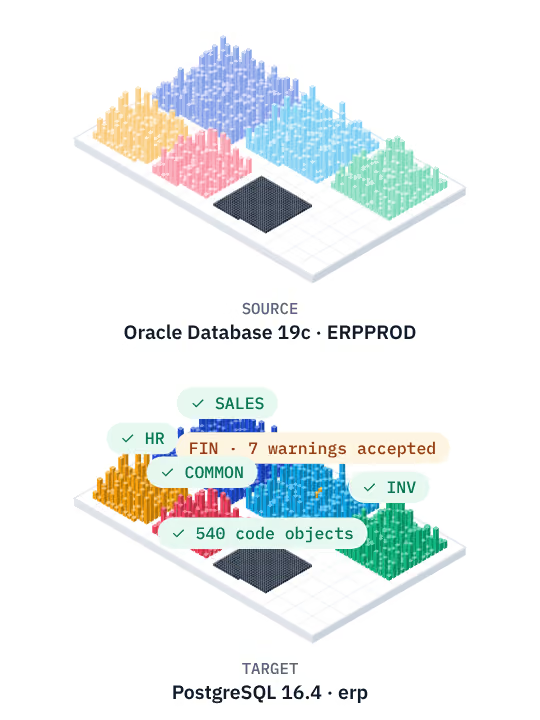
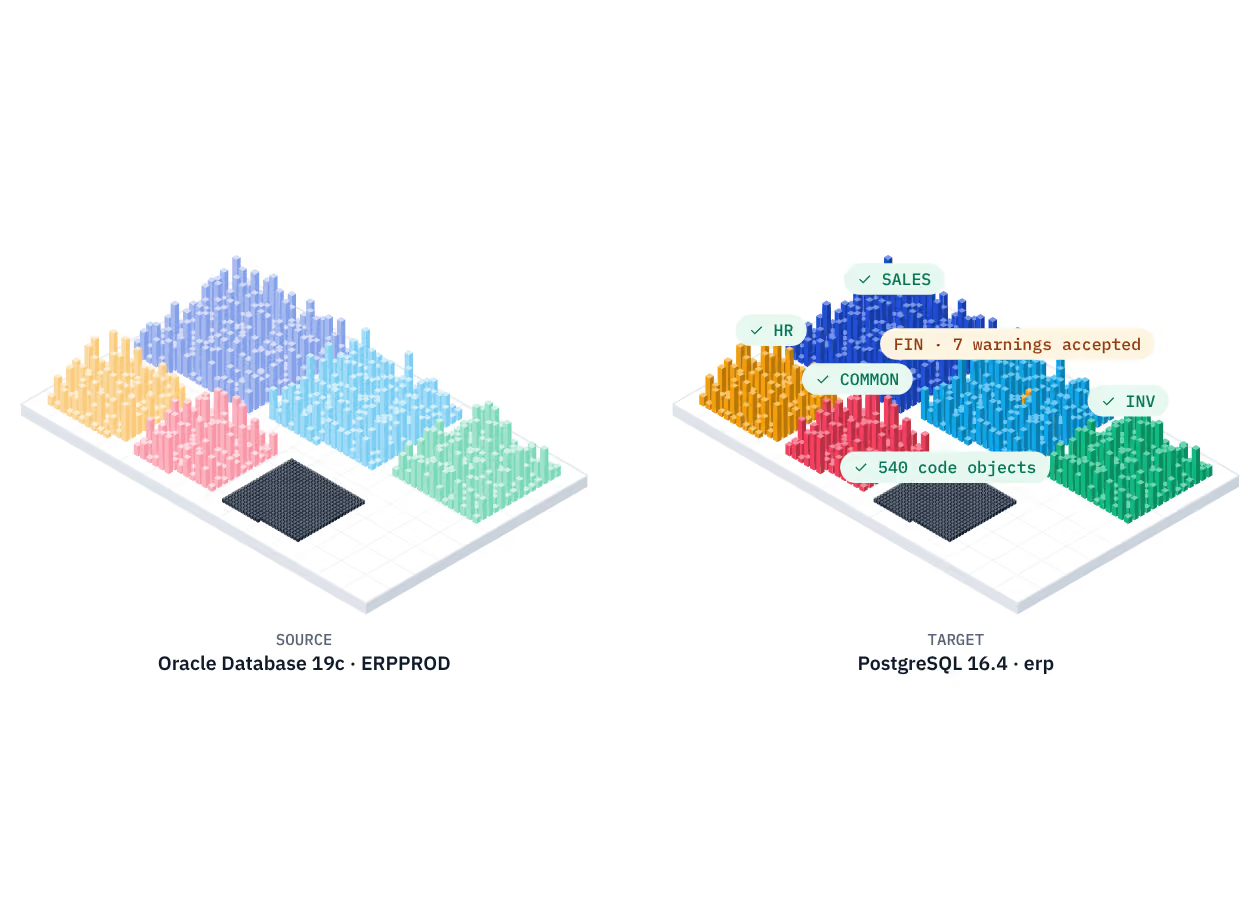
SALES312 tables

FIN248 tables · 7 warnings

INV196 tables

HR142 tables

COMMON138 tables

  • One square per table
  • Validated
  • Warning accepted
  • Failed

1,036 tables validated · 17,612 table check runs · 0 failed · 7 warnings accepted

Passed with warnings0 failed · 7 warnings accepted by Sarah Mitchell

Validation Report · ERP-Oracle to ERP-PG · 17,612 check runs
GroupResultStatus
CompletenessRow counts match on 1,036 tables, 2,141,876,402 rowsPass
AccuracyChecksums by chunk on all rows; 1,036,000 sample rows compared; 7 warnings: 412 values in 7 FIN columns rounded beyond 10 decimal places7 accepted
Structure71,940 columns; 11 mapping rules applied as planned; defaults; 688 sequences resetPass
Integrity7,969 primary key, foreign key, unique and check constraints holdPass
Code objects540 of 540 compiled; 61 functions executed on both databases, results equal; 88 triggers enabledPass
Performance readinessIndexes and statistics in place. Advisory, not part of the verdictAdvisory
How validation works

04 / How it works

From connection to cut-over

Five steps in one workspace, each producing a record the next step builds on.

  1. 1

    1. Connect

    Give Datalobe a read-only user on the source. It needs no write access to your source database.

    Migrations / ERP-Oracle to ERP-PG

    Step 1 of 5 · Connections

    ERP-OracleSource

    Engine
    Oracle Database 19c
    Database
    ERPPROD
    User
    DFLUX_RO

    Read-only verified

    ERP-PGTarget

    Engine
    PostgreSQL 16.4
    Database
    erp

    Connected

    Direct read-only connection · DFLUX_RO

  2. 2

    2. Assess

    Inventory every schema, table and code object. Score readiness and flag what needs a person.

    Migrations / ERP-Oracle to ERP-PG

    Step 2 of 5 · Assessment

    71of 100

    Ready with remediation
    Tables
    1,036
    Rows
    2,141,876,402
    Columns
    71,940
    Constraints
    7,969
    Indexes
    4,212
    Code objects
    540

    Top findings

    • DFLUX-301CONNECT BYINV.V_STOCK_POSITION and 17 views
    • DFLUX-305Package stateFIN.PKG_GL_POSTING and 9 packages
    • DFLUX-322NUMBER without precision1,284 columns

    10 objects flagged as likely needing manual work.

  3. 3

    3. Plan and convert

    Map types, convert code, review it, and get sign-off before anything moves.

    Migrations / ERP-Oracle to ERP-PG

    Step 3 of 5 · Decisions

    • NUMBER without precision → NUMERIC(38,10)Sarah Mitchell
    • CHAR(1) 'Y'/'N' → BOOLEANapproved

    Code objects: 540 of 540 converted; anything that cannot be proven goes to a named person.

    Plan approved 1 Oct 2026, 16:20 UTC

  4. 4

    4. Migrate

    Copy data in parallel, with change data capture (CDC) keeping the target current until cut-over.

    Data migration with CDC

    Migrations / ERP-Oracle to ERP-PG

    Step 4 of 5 · Data copy

    Rows copied

    2,141,876,402

    • SALES312 tables
    • FIN248 tables
    • INV196 tables
    • HR142 tables
    • COMMON138 tables
    Average
    43,100 rows/s
    Peak
    61,200 rows/s
    Copy time
    13h 48m

    Changes synced 1,204,318 · lag at cut-over 4 s

  5. 5

    5. Validate and switch over

    Run all checks, accept or fix what they find, then switch applications to the target.

    Migrations / ERP-Oracle to ERP-PG

    Step 5 of 5 · Validation

    Checks
    17,612
    Failed
    0
    Warnings accepted
    7
    • Row counts match on 1,036 tables
    • Values compared
    • Keys and constraints hold
    • 7 rounding warnings accepted by Sarah Mitchell
    • 61 functions give the same answers
    • Applications switched to ERP-PG, 4 Oct 2026, 02:00 UTC · downtime 18 min
See the full process

05 / Deployment

Run Datalobe where your data lives

Use Datalobe Cloud, or run the whole platform yourself, single-tenant, on request.

  • SaaS

    Datalobe Cloud

    Hosted and operated by Soulpage IT Solutions. Datalobe reads your source with a read-only database user you create.

  • Your cloud or data centre

    Self-hosted

    Install the full platform in your own cloud account or on your own servers, single-tenant, on request.

Your network

Oracle Database 19csource
PostgreSQL 16.4target
Read-only user

read-only

Datalobe platform

Soulpage IT Solutions is certified to ISO/IEC 27001:2022 and ISO 9001:2015.

Compare deployment options

06 / Documents

Five documents, one set of numbers

Each stage writes its own report from the same run data, so the figures agree from assessment to sign-off.

  • Illustration: the first page of the Assessment Report.

    Assessment Report

    Inventory, readiness and effort.

  • Illustration: the first page of the Migration Plan.

    Migration Plan

    Scope, decisions and approvals.

  • Illustration: the first page of the Validation Report.

    Validation Report

    Every check, with evidence.

  • Illustration: the first page of the Migration Report.

    Migration Report

    What moved, how fast, what changed.

  • Illustration: the first page of the Certificate of Migration.

    Certificate of Migration

    Sign-off record for auditors, issued when the verdict allows it.

See sample reports

07 / Paths

Supported migration paths

Oracle Database, SQL Server, MySQL and MariaDB to PostgreSQL, Snowflake or Databricks, on Datalobe Cloud or self-hosted.

Source databases (rows) and targets (columns)
SourcePostgreSQLSnowflakeDatabricks
Oracle DatabaseSupportedSupportedSupported
SQL ServerSupportedSupportedSupported
MySQLSupportedSupportedSupported
MariaDBSupportedSupportedSupported

Free assessment

Bring your hardest schema

Send one source database as a read-only connection or a schema export, and receive an Assessment Report within 5 working days of receiving it.